
Diario del sonno
Revisione paritaria di Dr Hayley Willacy, FRCGP Autore Danny ChadburnPubblicato originariamente 11 settembre 2017
Rispetta le linee guida editoriali
- ScaricaScarica
- Condividi
- Language
- Discussione
- Ask Patient
- Versione audio
- Aggiungi alle fonti preferite su Google
Please answer questions A to S each day over the next two weeks. There should be three sheets of paper for answers to be written in boxes. The aim is to measure the pattern and quality of your sleep, and factors that may affect your sleep over the course of two weeks.
Explore support for sleep difficulties
Get expert healthcare advice from the comfort of home. Complete a quick online consultation, available 24/7, with your request reviewed by a UK-registered clinician. Next day delivery available on eligible treatments.

Scelte video per Sonno e insonniaVideo library
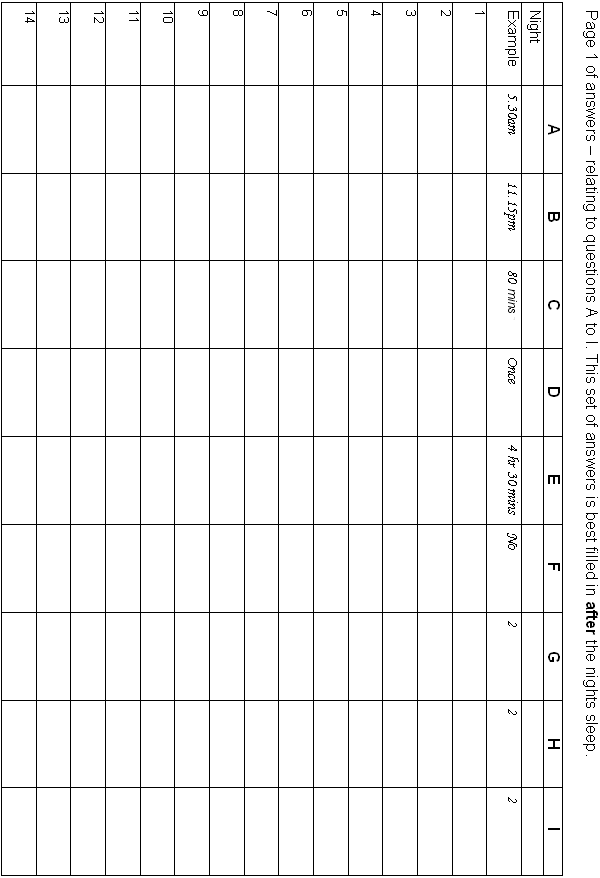
Questions A to I relate to the night's sleep. Try to answer these soon dopo getting up each day when the details of the previous night are fresh in your mind.
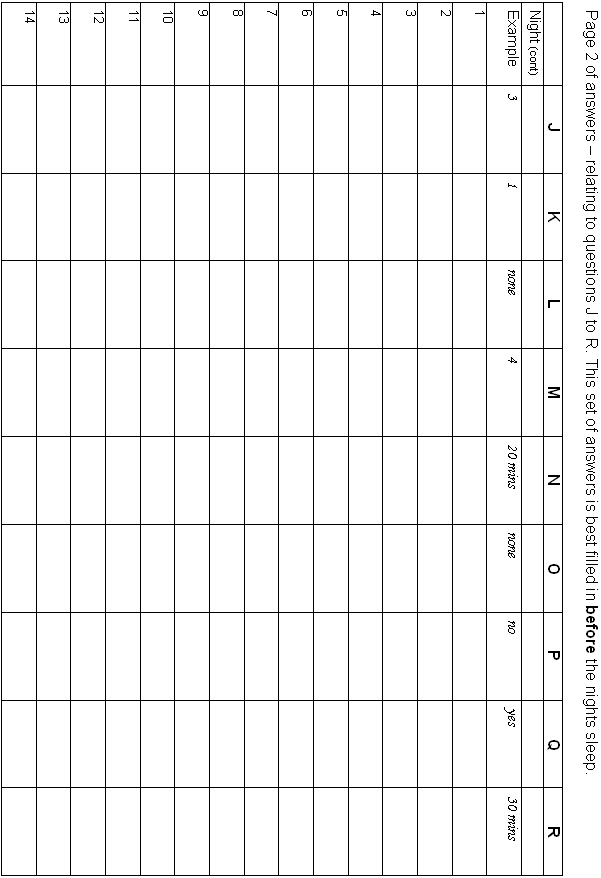
Questions J to S relate to to the day leading up to the night's sleep. Try to answer these at least an hour prima you go to bed when the details are fresh in your mind.
A. What time did you wake up this morning?
V. What time did you go to bed last night?
C. About how long did it take to first fall asleep? (Record in minutes - for example, 70 mins.)
D. How many times did you wake up during the night (enough to be fully aware)?
E. How long did you sleep last night in total? (In hours and minutes - for example, 4 hr 30 mins.)
C. Did you take any sleeping tablets last night to help you sleep?
G. How generally well do you feel today? Record on a scale 1-4. 1 - not well at all. 2 - just OK. 3 - fine. 4 - very well.
H. How energetic do you feel today? Record on a scale 1-4. 1 - lethargic. 2 - slow but OK. 3 - fine. 4 - very energetic.
I. How enjoyable was your sleep last night? Record on a scale 1-4. 1 - not at all. 2 - just OK. 3 - fine. 4 - very good.
J. How many cups of caffeine drinks (tea, coffee, cola, etc) did you have before 5 pm?
K. How many cups of caffeine drinks (tea, coffee, cola, etc) did you have after 5 pm?
E. How many units of alcohol did you have before 5 pm? One unit of alcohol is about equal to: half a pint of ordinary-strength beer/lager, or a small pub measure (25 ml) of spirits, or a standard pub measure (50 ml) of sherry or port, or a small glass of ordinary-strength wine.
M. How many units of alcohol did you have after 5 pm?
N. How much moderate or vigorous physical activity/exercise did you do before 9 pm? (Record in minutes - for example, 40 mins.) Moderate physical activity/exercise includes brisk walking, jogging, dancing, swimming, heavy DIY, gardening, etc.
I. How much moderate or vigorous physical activity/exercise did you do after 9 pm?
B. Did you take any street drugs (cocaine, amfetamines, heroin, etc)? Yes/No. If yes, write down which one(s).
Q. Did you have any naps during the day or evening? Yes/No.
R. If you did nap, how long in total were the naps? Record in minutes.
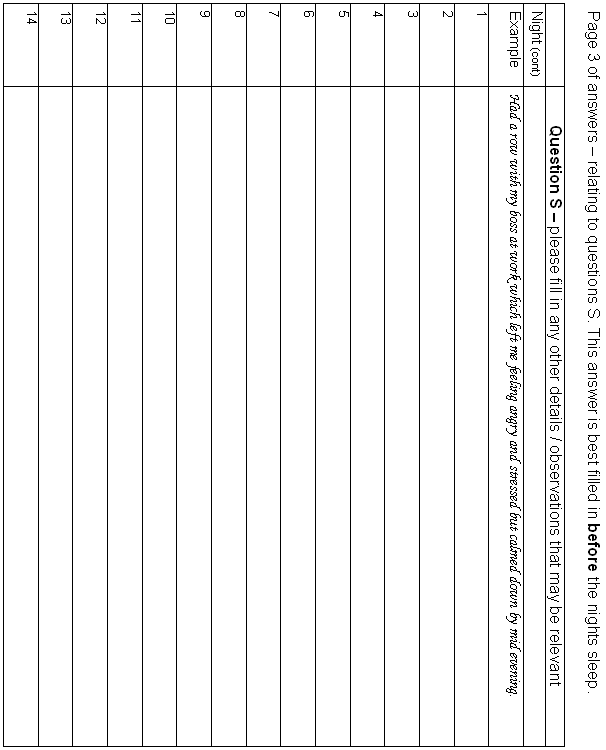
L. Fill in any other details that may be relevant. For example, if you were particularly stressed, anxious, depressed or ill.
sleep diary questions 1
Sleep diary question 2
Sleep diary questions 3
Scelte del paziente per Sonno e insonnia

Vita sana
Come smettere di russare e rovinare il tuo sonno
Con due persone su cinque che russano, è probabile che tu sia o quello che fa rumore o quello che resta sveglio ad ascoltarlo. Per alcuni, russare è un fastidio occasionale dopo qualche drink o un forte raffreddore. Per altri, è una battaglia notturna che lascia entrambi i partner esausti e può persino mettere a dura prova le relazioni. Fortunatamente, russare non è qualcosa con cui devi semplicemente convivere. Da soluzioni rapide che possono aiutare immediatamente a soluzioni a lungo termine che affrontano la causa sottostante, ci sono molti modi per dormire più serenamente.
di Heather Ainsworth

Vita sana
Consigli per dormire meglio in estate
Le notti luminose, le camere da letto calde e gli alti livelli di polline possono disturbare il tuo sonno in estate. Ecco alcuni consigli per dormire meglio in questo periodo dell'anno.
di Abi Millar
Informazioni sull'autore
Autore

Danny Chadburn
Responsabile dei Contenuti
Danny era il precedente Responsabile dei Contenuti presso Patient.
Informazioni sul recensoreVisualizza il profilo completo

Dr Hayley Willacy, FRCGP
Medico di base, Autore medico
MBChB (1992), DRCOG, DFFP, MRCOG (Part 1) MRCGP (2007), DFSRH (2013), MSc - medical education (2020)
La Dott.ssa Hayley Willacy era un medico di base del NHS che lavorava nel nord-ovest dell'Inghilterra, e si è ritirata dalla pratica clinica nel 2022 dopo 30 anni.
Storia dell'articolo
Articolo disponibile anche in Inglese, Tedesco, Spagnolo, Francese, Italiano, Portoghese, Hindi, Ebraico, Arabo, and Svedese.
11 settembre 2017 | Pubblicato originariamente
Autore:
Danny Chadburn
Revisione paritaria di
Dr Hayley Willacy, FRCGP
Condividi i tuoi pensieri o esperienze con gli altri nel nostro comunità di pazienti.
Iscriviti alla newsletter di Patient
La tua dose settimanale di consigli sulla salute chiari e affidabili - scritti per aiutarti a sentirti informato, sicuro e in controllo.
Abbonandoti accetti i nostri Informativa sulla Privacy. Puoi annullare l'iscrizione in qualsiasi momento. Non vendiamo mai i tuoi dati.