Zipped penis
Peer reviewed by Patient clinician teamLast updated by Dr Richard Draper, MRCGPLast updated 18 Mar 2011
Meets Patient’s editorial guidelines
- DownloadDownload
- Share
- Language
- Discussion
- Audio Version
- Add to preferred sources on Google
This page has been archived.
It has not been reviewed recently and is not up to date. External links and references may no longer work.
Medical Professionals
Professional Reference articles are designed for health professionals to use. They are written by UK doctors and based on research evidence, UK and European Guidelines. You may find one of our health articles more useful.
Description
An area of skin, often of the penis or neck, becomes painfully trapped in a zipper mechanism. Unzipping the zipper will lacerate the skin and cause further damage.
Epidemiology
This condition is relatively rarely seen, but is the most common cause of prepuce injuries in children. In one study, only 6 boys were seen over a period of 3 years.1In another, there was only one case of zip entrapment in 4,068 new patient attendances.2
Management
Various options can be tried, some more invasive than others. It is usually necessary to dismantle the zip. If the skin trapped is minor and recent, dismantling the zip from below will sometimes work. If this is not successful then a technique to release the pressure between the zip plates will free the trapped skin. The options include the following:
It may be possible to dismantle the zip. If the median bar at the front of the moveable zip head is cut in half, the zipper falls apart freeing the skin relatively painlessly. Use bone cutter or wire clippers for this. Considerable force may be needed.
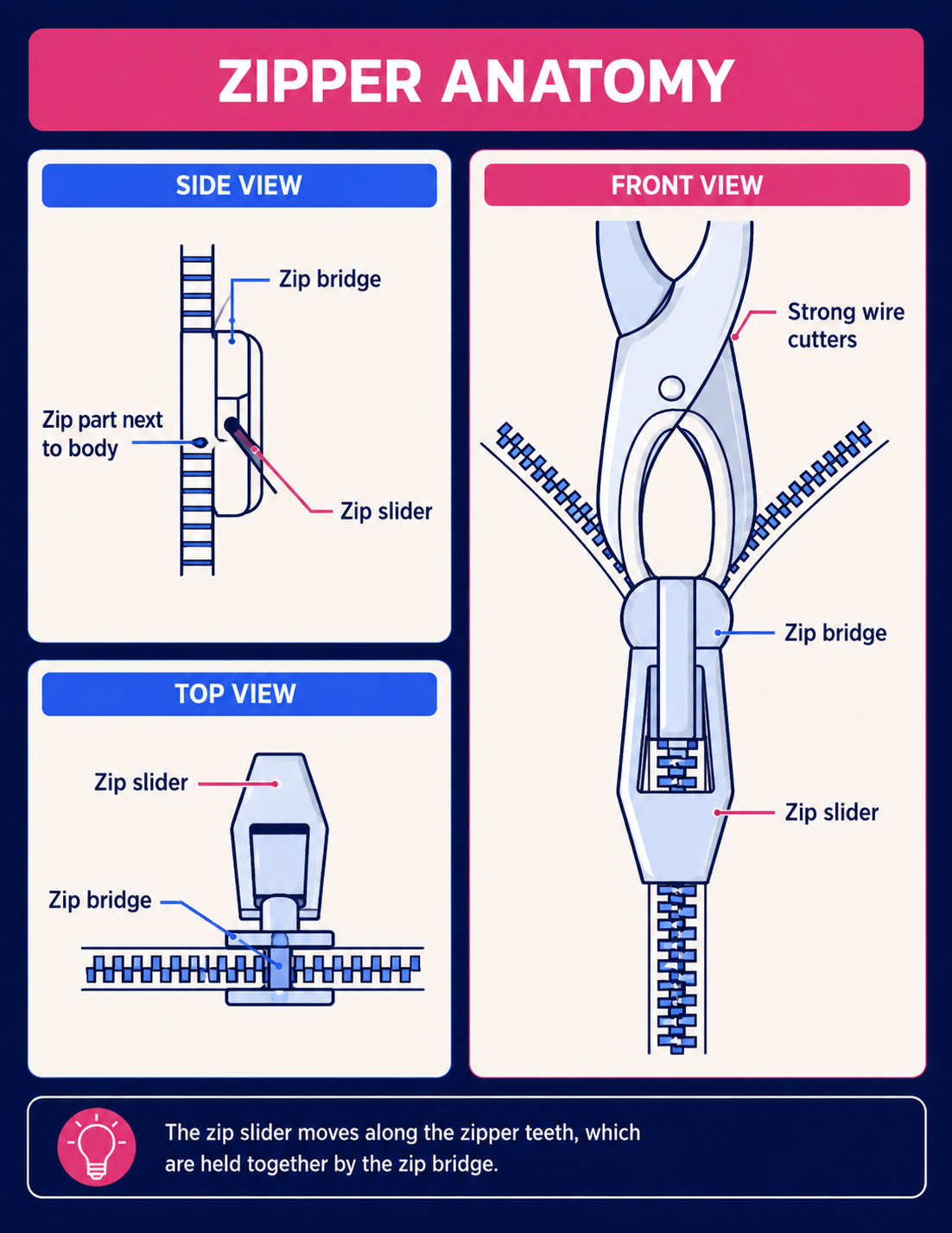
Lateral compression of the zip, using pliers, sometimes frees the prepuce.3
Cutting the teeth of the closed zipper is sometimes effective.4
The thin blade of a small screwdriver can be inserted between the outer and inner faceplates of the zip fastener and a twisting movement made toward the median bar. This will widen the gap between faceplates and may help to disengage the prepuce.5
If all else fails, the skin should be anaesthetised and the area of zipper and entrapped tissue should be excised. Mineral oil is sometimes used in these circumstances to lubricate the area and minimise trauma.6
Consider plastic surgical follow-up if the skin damage is significant.
Exclusive updates for healthcare professionals
Stay informed with the latest clinical updates, professional insights, and evidence-based guidance. The Patient Pro newsletter curates essential content for healthcare professionals—delivered straight to your inbox.
By subscribing you accept our Privacy Policy. You can unsubscribe at any time. We never sell your data.
Further reading and references
- Yip A, Ng SK, Wong WC, et al; Injury to the prepuce. Br J Urol. 1989 May;63(5):535-8.
- Wyatt JP, Scobie WG; The management of penile zip entrapment in children. Injury. 1994 Jan;25(1):59-60.
- Mishra SC; Safe and painless manipulation of penile zipper entrapment. Indian Pediatr. 2006 Mar;43(3):252-4.
- Inoue N, Crook SC, Yamamoto LG; Comparing 2 methods of emergent zipper release. Am J Emerg Med. 2005 Jul;23(4):480-2.
- Raveenthiran V; Releasing of zipper-entrapped foreskin: a novel nonsurgical technique. Pediatr Emerg Care. 2007 Jul;23(7):463-4.
- Mydlo JH; Treatment of a delayed zipper injury. Urol Int. 2000;64(1):45-6.
About the authorView full bio

Dr Richard Draper, MRCGP
General Practitioner, Medical Author
MB, ChB, DCH, DRCOG, MRCGP, DA (UK)
Dr Richard Draper qualified in 1981 and has worked 24 years in general practice, currently as a GP partner, Oxshott Medical Practice, Oxshott Surrey.
About the reviewerView full bio

Patient clinician team
The Patient.info Clinical Team creates and reviews our health content to ensure it is accurate, evidence-based, and guided by trusted NHS and NICE standards.
Article history
The information on this page is written and peer reviewed by qualified clinicians.
Article also available in English, German, Spanish, French, Italian, Portuguese, Hindi, Hebrew, Arabic, and Swedish.
18 Mar 2011 | Latest version

Ask, share, connect.
Browse discussions, ask questions, and share experiences across hundreds of health topics.

Feeling unwell?
Assess your symptoms online for free
More in emergency medicine and trauma
- Abdominal trauma
- Ankle injuries and sprains
- Atrial fibrillation
- Blast injury
- Fragility fractures
- Hereditary angio-oedema
- Interstitial nephritides and nephrotoxins
- Needle pericardiocentesis
- Pleural effusion aspiration
- Rabies
- Ruptured aortic aneurysm
- Sarin poisoning
- Snake bites
- Spinal disc problems
- Supraventricular tachycardia in adults
- Torsades de pointes
- Toxic shock syndrome
- Wound management and suturing
- Wrist fractures