Can we trust BMI charts for kids?
Peer reviewed by Dr Sarah JarvisLast updated by Kerry Taylor-SmithLast updated 21 Aug 2019
Meets Patient’s editorial guidelines
- DownloadDownload
- Share
- Language
- Discussion
- Audio Version
- Add to preferred sources on Google
Obesity is an ever-increasing problem in the UK, where it is estimated that one in five children aged between 4 and 5 years are overweight or obese, rising to one in three by the time they are aged 10-11 years.
Need weight loss treatment?
Start a quick online consultation through Patient.info, available 24/7.
Reviewed by UK-registered clinicians and powered by Evaro, a UK-regulated healthcare service. Treatment can often be delivered next day.

These figures result from the National Child Measurement Programme (NCMP), which assesses how children are growing. Children are measured in their reception year (aged 4-5 years) and again in year 6 (aged 10-11 years). Healthcare professionals record their height and weight, as well as age and gender, to determine their body mass index, or BMI.
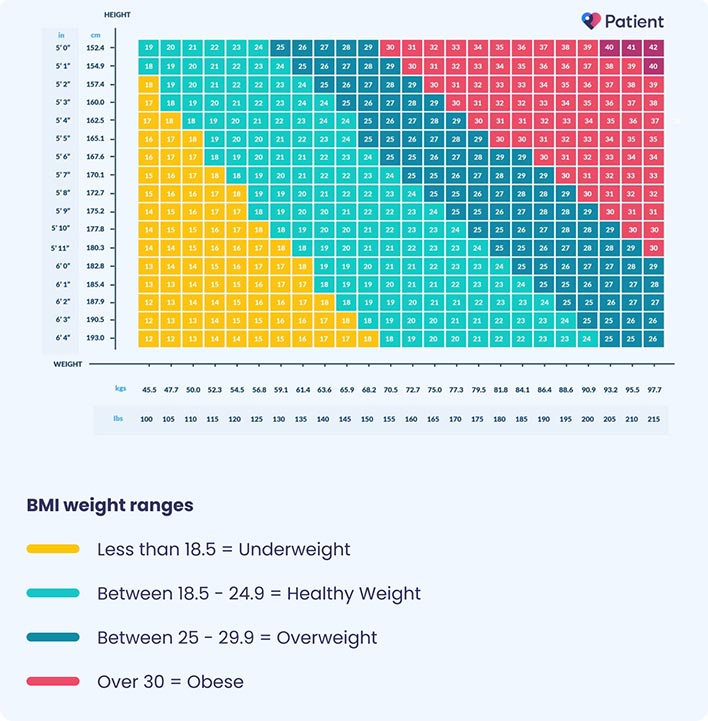
BMI is a relatively straightforward and convenient means of assessing someone's weight to determine if they are within a healthy range. It's calculated by dividing a person's body mass in kilograms by their height squared.
What do the numbers mean?
For adults, a figure between 18.5 and 24.9 is considered a healthy weight. For children, their BMI is expressed as a centile and compares their value to other children who took part in the NCMP.
Children are considered underweight if they fall on the second centile or below, a healthy weight if they fall between the second and 91st centile, and overweight if they are on the 91st centile or above. Children on the 98th centile or above are considered very overweight.
What this means is that, for example, if your child falls on the 57th centile, they are heavier than 57 out of 100 children of the same age and gender, and that they are a healthy weight.
The limitations of BMI
But BMI is not without its limitations. "It's a reasonable measure - but not entirely accurate. If you are super fit and have a lot more muscle than average, for example, you may be classed as overweight or obese," explains Dr Sally Norton, an NHS weight loss consultant. "And young children naturally have different body compositions to adults, so standard BMI measurement can be inaccurate and should be age-adjusted as appropriate."
"BMI can provide inaccurate assessment of body fat levels, particularly in children, for several reasons," adds Mohammed Hudda, a Research Fellow in Epidemiology and Medical Statistics at St George's, University of London. "Firstly, as it is based on weight, it does not discriminate between the two components of weight: fat and lean mass, which can vary substantially between individuals with the same BMI.
"Secondly, the calculation can result in taller children having a higher BMI," continues the British Heart Foundation-funded researcher.
In addition, research shows BMI is not a good measure of body fat in children of different ethnic origins, overestimating it in children of black African descent, and underestimating it in children of South Asian origins, compared to their white peers.
Hudda's research focuses on finding better ways of using weight and height as a measure of body fat in children. Initially, it aimed to improve the assessment of body fat in children of different ethnic origins by making BMI adjustments in these children compared to white Europeans.
"However, this approach does not tackle the other limitations of BMI," states Hudda. "Our most recent research proposes an alternative method for assessing body fat in British children aged 4-15, based primarily on height and weight measurements."
Hudda's team derived an equation which uses height, weight, sex, age and ethnicity (if available) to estimate lean mass, which can be subtracted from weight to estimate fat mass; testing showed that it estimated fat levels very accurately.
"This approach could improve the accuracy of assessments for body fat in children, compared with those provided by BMI, to allow for more effective surveillance, prevention and management of childhood obesity," says Hudda.
How other methods measure up
When measuring an adult's BMI, their waist circumference can be taken into account as it is a good way of checking a person is not carrying too much fat around their stomach (this so-called 'intra-abdominal fat' is far more dangerous to your health than other types of fat). But this measurement is not routinely taken in children as it doesn't consider the child's height. However, it is a measurement that varies with obesity and can point towards cardiovascular disease risk in children.
Researchers from the University of Wolverhampton have trialled a new measurement index which combines height, weight and waist circumference to give a simple, meaningful and more accurate index related to percentage body fat.
"BMI has historically been used to assess weight status, although it underestimates the extent of the obesity prevalence," states lead researcher and biostatistics specialist Professor Alan Nevill.
"A move to incorporate measures of waist circumference into BMI is logical, as measures of centralised obesity are likely to increase the ability and sensitivity of BMI in detecting cardiovascular and cardiometabolic disease."
Nevill, who is Professor of Sport at the university, and his colleagues have assessed nearly 6,000 children with their proposed index and published their findings in Pediatric Obesity. Work is now underway to see if it is as equally effective in adults.
BMI is a widely used tool to estimate the amount of weight a child is carrying compared to their height; for the majority of children it works very well and feeding your child's height and mass into a BMI centile chart, comparing them with others of their age and sex, will give a rough idea of whether they are a healthy weight.
If you are concerned about your child's weight, a trip to the GP will help determine what action may be necessary.
Norton also has this advice: "You obviously don't want to make an issue of it. Instead, see it as an opportunity to improve the whole family's lifestyle and lead by example. Cutting back on sugar; drinking water at every meal and avoiding fizzy drinks; choosing healthier alternatives to favourite junk food; cutting down on snacking and making family activity part of your life are all great ways to start. And don't underestimate the value of good sleep - it has a big impact on health and weight. Ban electronic devices (phones, laptops and tablets) for at least two hours before bed, keep them out of bedrooms and make sure children keep a good sleep routine."
Patient picks for Obesity and weight loss
Healthy living
The most common reasons you're not losing weight
If you're worried about not reaching your ideal weight - despite recently shedding some pounds - we explore potential reasons why your weight loss may have plateaued.
by Victoria Raw
Healthy living
Do crash diets ever really work for healthy weight loss?
Crash diets aren't generally seen as a sensible way to lose weight. Tell your friends you're considering such a diet, and you probably won't be met with much encouragement - it's practically a truism that there are no quick fixes to weight loss. However, a recent study has cast doubt on the received wisdom, by claiming that meal replacement diets might actually work better than conventional approaches.
by Abi Millar
Frequently asked questions
Why is it important to use age-adjusted BMI for children?
Standard adult BMI measurements can be inaccurate for children because their body compositions naturally differ from adults'. Using age-adjusted measurements helps to account for these differences, providing a more appropriate assessment for younger individuals.
Can high muscle mass affect a child's BMI result?
Yes, if a child is very active or muscular, their BMI might suggest they are overweight or even very overweight, even if they have a low body fat percentage. This is because BMI does not distinguish between fat and lean muscle mass.
Why might children of different ethnic origins have varied BMI assessments?
Research indicates that BMI may not be an equally accurate measure of body fat across different ethnic origins. It can overestimate body fat in children of black African descent and underestimate it in children of South Asian origins when compared to their white peers.
Are there newer methods being developed to assess body fat in children more accurately than BMI?
Yes, researchers are developing alternative methods. For example, one approach involves using height, weight, sex, age, and ethnicity to estimate lean mass, which is then subtracted from total weight to estimate fat mass. Another method combines height, weight, and waist circumference to create a more accurate index related to body fat percentage, which is being trialled.
What is the significance of waist circumference when assessing body fat?
In adults, waist circumference is a good indicator of 'intra-abdominal fat', which is considered more dangerous to health than other types of fat. While not routinely taken in children because it doesn't consider height, it is a measurement that can vary with obesity and may indicate a risk for cardiovascular disease in children.
About the authorView full bio

Kerry Taylor-Smith
Freelance journalist
BSc (Hons) Natural Sciences
Kerry has been a freelance writer, editor and proofreader since 2016; she specialises in science and health-related topics.
About the reviewerView full bio

Dr Sarah Jarvis
Clinical Consultant
MA (Cantab), BM, BCh (Oxon), DRCOG, FRCGP, MBE
After training in medicine at Cambridge and Oxford, Dr Sarah Jarvis MBE became a GP.
Article history
Article also available in English, German, Spanish, French, Italian, Portuguese, Hindi, Hebrew, Arabic, and Swedish.
21 Aug 2019 | Latest version
Join the conversation
Share your thoughts or experiences with others in our patient communities.

Ask, share, connect.
Browse discussions, ask questions, and share experiences across hundreds of health topics.

Feeling unwell?
Assess your symptoms online for free
Sign up to the Patient newsletter
Your weekly dose of clear, trustworthy health advice - written to help you feel informed, confident and in control.
By subscribing you accept our Privacy Policy. You can unsubscribe at any time. We never sell your data.
More in healthy living
- 5 benefits of reading
- 6 health benefits of swimming
- 7 ways to ease 'morning dread' during perimenopause
- AI skin analysis: what it is and why experts warn against it
- Are dance workouts good for keeping fit?
- Biohacking - where to start, and where to stop
- NewBruxism and stress - how anxiety can affect your teeth
- Does cold weather boost weight loss?
- Have a healthy, happy Father's Day
- UpdatedHeartburn at night: how to improve sleep quality with heartburn
- How gut bacteria affect mood, focus and brain health
- More evidence that social media is associated with teenage depression
- Not quite 'back to normal': a guide to post-pandemic family healing
- Safer than cigarettes? The rise of vaping in schools
- Size matters: why our oversized portions are contributing to the obesity crisis
- Switch off TV in the bedroom to avoid weight gain
- What the World Cup can teach us about staying active
- Why fad diets can actually lead to weight gain
- Women's health in sport: injuries, menstruation, and motherhood