Earwax
Peer reviewed by Dr Doug McKechnie, MRCGPLast updated by Dr Philippa Vincent, MRCGPLast updated 14 Nov 2024
Meets Patient’s editorial guidelines
- DownloadDownload
- Share
- Language
- Discussion
- Audio Version
- Add to preferred sources on Google
In this series:Hearing lossHearing loss of older peopleGlue earOtosclerosisPerforated eardrumCholesteatoma
A build-up of earwax can cause reduced hearing and sometimes other symptoms. Earwax can usually be easily removed.
At a glance
Earwax is a natural protective coating in your ear canal.
Too much earwax can cause dulled hearing, fullness in the ear, or ringing.
You can use ear drops from a pharmacy to soften earwax.
Microsuction is considered a safe way to remove earwax.
Do not try to clean inside your ear with cotton buds.
What is earwax?
Earwax in ear canal
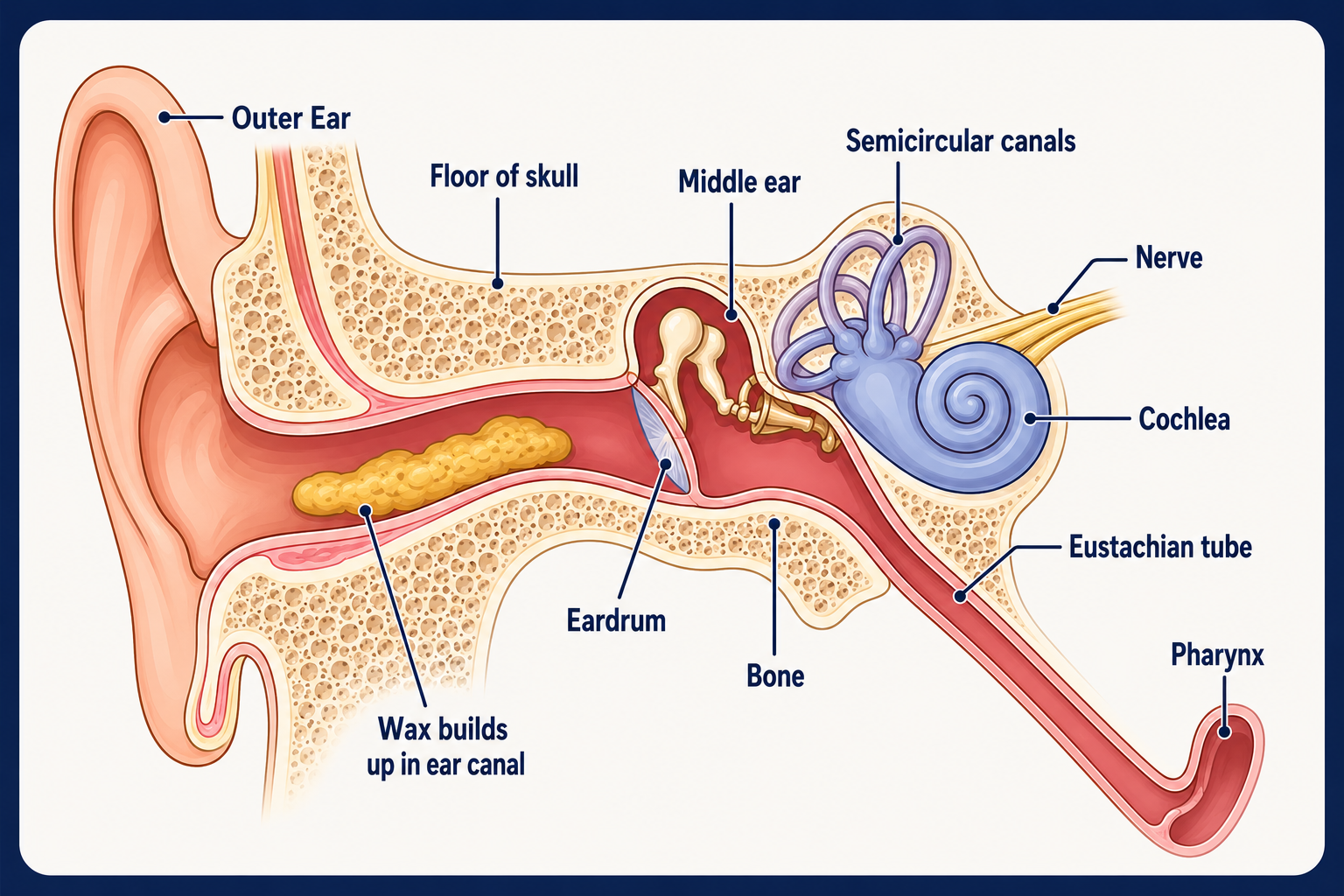
Earwax is a build-up of dead cells, hair, foreign material such as dust, and cerumen. Cerumen is the natural wax produced by glands in the ear. It forms a protective coating of the skin in the ear canal. Small amounts are made all the time. Flakes or crusts of earwax break off and fall out of the ear from time to time.
The quantity of earwax made varies greatly from person to person. Some people form plugs of earwax in their ear canal. This may cause a feeling of fullness and dulled hearing. It can feel uncomfortable. A hard plug of earwax can also sometimes cause 'ringing in the ear' (tinnitus) or occasionally even a mild type of dizziness (vertigo).
A clinician can look into the ear canal and confirm that a plug of earwax has formed. A plug of earwax is not a serious problem but can be a nuisance. Earwax only needs to be removed if it is causing symptoms such as reduced hearing. Earwax may also need to be removed for fitting of a hearing aid, or if the eardrum needs to be examined.
Note: do not try to clean the ear canal with cotton wool buds, etc. This can make things worse as earwax can be pushed deeper inside. It may also cause an ear infection or even damage the eardrum itself. It is best to let the ear clean itself.
What can I do if earwax builds up and causes symptoms?
Ear drops
Ear drops, which can be bought from pharmacist, will often clear a plug of earwax without the need for any more treatment. For example, olive oil, almond oil, sodium bicarbonate, and sodium chloride ear drops are commonly used for this purpose.
The drops should be kept at room temperature before using them. (Let the bottle stand in the room for about half an hour.) Pour a few drops into the affected ear. Lie with the affected ear uppermost when putting in drops. Stay like this for 2-3 minutes to allow the drops to soak into the earwax.
The earwax is softened and it often breaks up if you put drops in 2-3 times a day for 3-7 days. Flakes or crusts of earwax often fall out bit by bit.
Ear microsuction
Microsuction is considered to be one of the safest ways of removing ear wax. A trained practitioner uses a microscope to look into the ear as the wax is suctioned away without using water. This is available on the NHS in some GP surgeries and in ear, nose and throat departments at hospitals. It is also available in many private clinics across the UK.
Ear irrigation (syringing)
Ear irrigation was a traditional method of removing ear wax. Ear irrigation involves lukewarm water being squirted into the ear canal which dislodges the wax plug which then falls out with the water. Although ear irrigation was mostly successful and painless there were complications associated with it in some instances (for example, damage to the eardrum, inflammation or infection). Ear irrigation is rarely offered any longer by GP surgeries, due to these risks and the fact that it is not part of the NHS contract.
Can I prevent a build-up of earwax?
Some people are troubled by repeated build-up of earwax and require earwax removal every so often. In this situation, to prevent earwax building up and forming a plug, some doctors recommend using ear drops regularly - for example, olive oil ear drops. Some people also buy a bulb syringe to use at home to perform their own irrigation.
However, there is no clear research evidence on this issue. For example, it is not clear how often the drops should be used and different doctors advise different things - from daily, to once a fortnight. It is also not clear if regular use of ear drops does actually prevent earwax from building up. However, people troubled by build-up of earwax may wish to try using ear drops on a regular basis to see if this prevents the problem.
Patient picks for Hearing problems
Ear, nose and throat
Perforated eardrum
A burst (perforated) eardrum is usually not serious and often heals in a few weeks on its own. Complications sometimes occur, such as hearing loss and infection in the middle ear. A small procedure to repair the eardrum may be an option if it does not heal by itself, especially if the perforation causes hearing loss.
by Dr Surangi Mendis, MRCGP

Ear, nose and throat
Hearing loss of older people
Most people over the age of 60 develop some hearing loss. The severity can vary greatly from person to person. Hearing aids and equipment to help when you have hearing loss can make a big difference to your quality of life. If you are concerned about your hearing, don't suffer in silence - discuss this with your doctor.
by Dr Mary Harding, MRCGP
Frequently asked questions
What does cerumen mean?
Cerumen is the medical term for the natural wax produced by glands in the ear canal. It forms a protective coating for the skin inside the ear.
How often do I need to get rid of earwax?
Earwax only needs to be removed if it's causing symptoms like reduced hearing, if you need a hearing aid fitted, or if a doctor needs to examine your eardrum. Otherwise, the ear generally cleans itself.
Can ear microsuction cause any problems?
The article states that microsuction is considered one of the safest ways to remove earwax. It involves a trained practitioner using a microscope to view and suction away the wax without using water.
Is ear syringing still used to remove earwax?
Ear irrigation, also known as syringing, is rarely offered by GP surgeries anymore due to associated risks such as potential damage to the eardrum, inflammation, or infection, and because it is no longer part of the NHS contract. Microsuction is now a more common method.
Can I prevent earwax from building up regularly?
For people who frequently experience earwax build-up, some doctors suggest using ear drops regularly, such as olive oil, to try and prevent large plugs from forming. While there's no strong research about how effective this is or how often drops should be used, some choose to try it if they are troubled by repeated build-up.
Further reading and references
- Hearing loss in adults: assessment and management; NICE Guideline (June 2018 - last updated October 2023)
- Aaron K, Cooper TE, Warner L, et al; Ear drops for the removal of ear wax. Cochrane Database Syst Rev. 2018 Jul 25;7:CD012171. doi: 10.1002/14651858.CD012171.pub2.
- Earwax; NICE CKS, May 2023 (UK access only)
About the authorView full bio
Updated by

Dr Philippa Vincent, MRCGP
General Practitioner, Medical Author
MB BS, Bsc, MRCGP (2000), DCH, DFSRH, DRCOG
Dr Philippa Vincent is an NHS GP working in North London.
About the reviewerView full bio

Dr Doug McKechnie, MRCGP
Medical Writer
MA, MBBS, MSc, DRCOG, MRCP(UK), MRCGP(2021), FHEA
Dr Doug McKechnie is an NHS GP working in London. He works full-time clinically and is also the Deputy Lead for the Clinical and Professional Practice module at University College London Medical School.
Join the conversation
Share your thoughts or experiences with others in our patient communities.

Ask, share, connect.
Browse discussions, ask questions, and share experiences across hundreds of health topics.

Feeling unwell?
Assess your symptoms online for free
Sign up to the Patient newsletter
Your weekly dose of clear, trustworthy health advice - written to help you feel informed, confident and in control.
By subscribing you accept our Privacy Policy. You can unsubscribe at any time. We never sell your data.