10 home remedies for fast migraine relief
Migraine remedies
Peer reviewed by Dr Colin Tidy, MRCGPAuthored by Heather AinsworthOriginally published 22 Oct 2025
Meets Patient’s editorial guidelines
- DownloadDownload
- Share
- Language
- Discussion
- Audio Version
- Add to preferred sources on Google
Migraines are more than ‘just a headache.’ They can be intense, throbbing, and often come with feeling sick, light sensitivity, and the need to shut out the world. If you’ve ever found yourself desperate for relief but unsure about what works - you’re not alone.
Fortunately, there are several effective ways to manage migraines right at home.
Need treatment for migraines?
Start a quick online consultation through Patient.info, available 24/7.
Reviewed by UK-registered clinicians and powered by Evaro, a UK-regulated healthcare service. Treatment can often be delivered next day.

Migraines can strike at the worst times - whether you’re working from home on a deadline, juggling the chaos of parenting, or simply trying to unwind in front of the TV.
The pain, sensitivity to light, and brain fog can make even simple tasks feel impossible. When a migraine hits, fast relief becomes the top priority.
While not every remedy works for everyone, these home remedies are some of the most effective for easing symptoms and helping you get back on track with your day.
© Patient / Heather Ainsworth
Migraine remedies
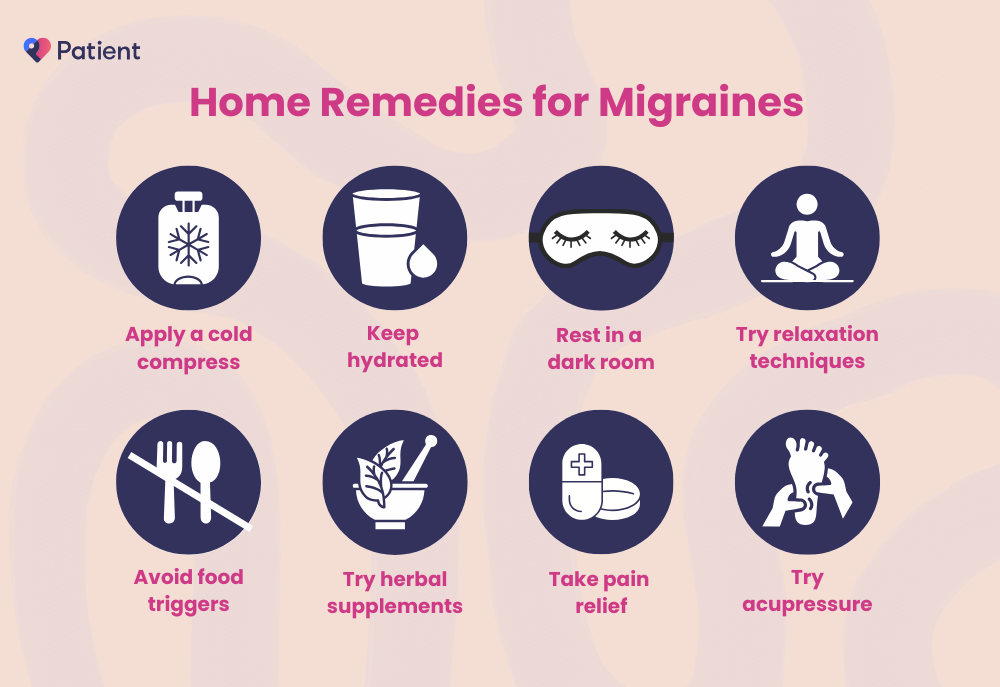
1. Apply a cold compress
Using a cold compress on your forehead, neck, or temples, and moving to a cooler environment may help reduce the severity of a migraine attack.1
Use the cold compress for 15-20 minutes at a time, then take a 15 minute break before reapplying. Always ensure a cold pack is wrapped in a tea towel to avoid damaging your skin.
2. Stay hydrated
Dehydration can trigger or worsen migraines. 2Sip cold water slowly as rapid drinking can upset your stomach or cause brain freeze.
You can also try drinking coconut water or an electrolyte drink if you’ve been sweating a lot or having trouble eating. Aim to stay consistently hydrated throughout the day to prevent migraines from getting worse or coming back.
3. Rest in a dark, quiet room
Light and noise are major migraine triggers.3 Resting in a dark, quiet room as soon as a migraine starts may help ease symptoms.
Try:
Closing any curtains or blinds, switching off electronics, and resting your head.
Using an eye mask and earplugs for added comfort.
Even 20-30 minutes of rest in a peaceful environment could significantly reduce pain.
4. Try deep breathing or relaxation techniques
Stress is one of the most common migraine triggers.4 Adding relaxation into your daily routine may help prevent and relieve migraines.
Try:
Deep breathing: inhale slowly for 4 seconds, hold for 4, and exhale for 4, and repeat.
Gentle yoga or stretching: stretch your neck or shoulders to help remove tension.
Regular relaxation practice could lower stress hormones and improve overall migraine control.
5. Take supplements
Supplements including magnesium, vitamin B2 (riboflavin), coenzyme Q10, vitamin D, and omega-3 may help manage and prevent migraines by improving energy levels in brain cells, calming nerve activity, and reducing inflammation.5
You should take them daily for several months to determine if they are effective.
6. Try acupressure
Applying pressure to specific points on the body may promote relaxation, improve blood flow, and reduce muscle tension, which may lessen the intensity or frequency of migraine pain.6
Common pressure points for migraine relief are the head, face, arms, hands, and feet.
7. Limit screen time
Limiting screen time could help reduce migraines by preventing eye strain, bright light exposure, and overstimulation that can trigger or worsen headache pain.7
If you really need to be viewing a screen, try turning down the brightness to help with light sensitivity.
8. Try herbal remedies
Some herbal remedies such as peppermint, ginger, and lavender oil, might help relieve migraine symptoms by relaxing muscles,8 reducing inflammation,9 and blocking pain signals.10
Try:
Putting a few drops of diluted peppermint oil into a bath.
Taking a ginger supplement or massaging diluted essential ginger oil into your temples.
Adding a few drops of lavender oil into hot water and inhaling the vapour or massaging it into the skin.
9. Avoid food triggers
Avoiding common food triggers such as aged cheeses, processed meats, chocolate, alcohol, caffeine , artificial sweeteners, and pickled or fermented foods, may help prevent migraines from happening or worsening.11
Triggers can vary from person to person, so keeping a food and symptom diary can help identify personal sensitivities.
10. Take non-steroidal anti-inflammatory drugs (NSAIDs)
Sometimes, combining natural remedies with medicine is the most effective approach for quick pain relief.
Common over-the-counter NSAIDs include:
Ibuprofen.
Aspirin.
For best results, take the medicine as soon as symptoms begin. Avoid frequent use - more than twice a week - as overuse can lead to rebound headaches.
When to see a doctor for migraines
Dr Katy Munro, GP and Senior Headache Specialist at the National Migraine Centre, explains: “You should seek urgent medical attention if you experience any of the following:
Sudden, severe headache.
A new headache with fever, neck stiffness, or altered mental status.
Weakness, vision loss, or confusion.
A headache with painful red eye and changes to your vision.
A headache after trauma - such as a fall.
A headache if you have a weak immune system, are pregnant, or have cancer.
Any of these symptoms could be a sign of something serious that requires emergency treatment.
"See a doctor if your migraine is not responding to treatment, is getting worse over time, or lasts longer than 7 days,” she says.
Summary
For fast migraine relief at home you should stay hydrated, rest in a dark room, use a cold compress, try relaxation techniques, limit screen time, avoid food triggers, and take NSAIDs.
Everyone’s migraine triggers are different, so try a few strategies to see what works best for you, and keep track of patterns with a migraine trigger diary.
For more information on how to treat migraines, read our information leaflet called migraine treatment.
Patient picks for Migraine

Brain and nerves
Can Botox cure your migraines?
Most of us suffer from a headache from time to time. But imagine having several debilitating migraines per week, often accompanied by nausea or vomiting. Janet Falcondale, 46, from North Yorkshire, has suffered from headaches and migraines since childhood. "My migraines often start with an aura - a visual problem that causes blind spots. I've had to take time off work, and have been laid up in bed for days at a time," she explains. Migraines are often debilitating, meaning sufferers of frequent attacks can experience a great deal of disruption to their daily lives. From lost opportunities at work, poor performance due to presenteeism and even hospital admission, having regular migraines can be a real pain.
by Gillian Harvey

Brain and nerves
Is your period causing your migraines?
Headaches and migraines are a common problem that affect both sexes. But women tend to be more frequently affected. This is thought to be due to the influence of hormones. Interestingly, most women who experience migraines remember their first attack occurring around the time they started their period. So what can you do if menstrual migraines are affecting your quality of life?
by Dr Jennifer Kelly, MRCGP
Frequently asked questions
When should I consider seeing a doctor for my migraines?
You should seek urgent medical attention for a migraine if you experience a sudden, severe headache; a new headache accompanied by fever, neck stiffness, or altered mental status; weakness, vision loss, or confusion; a headache with a painful red eye and changes to your vision; a headache after trauma like a fall; or a headache if you have a weak immune system, are pregnant, or have cancer. These symptoms might indicate a serious condition requiring emergency treatment. Additionally, you should consult a doctor if your current migraine treatment isn't working, your migraines are worsening over time, or if an attack lasts longer than seven days.
How long does it typically take for supplements to show an effect on migraines?
Supplements like magnesium, vitamin B2 (riboflavin), coenzyme Q10, vitamin D, and omega-3 may help manage and prevent migraines. For these to be effective, you should take them daily for several months to determine if they are working for you.
What is rebound headache and how can I avoid it?
Rebound headaches can occur from the frequent use of non-steroidal anti-inflammatory drugs (NSAIDs) for migraine relief. To avoid this, it's recommended to limit the use of these medications to no more than twice a week.
Are there any specific breathing exercises that can help with migraine relief?
Yes, deep breathing can be a helpful relaxation technique. To practice this, slowly inhale for four seconds, hold your breath for four seconds, and then exhale for four seconds. Repeating this can help lower stress hormones and improve overall migraine control.
How can I identify my personal migraine triggers, especially related to food?
To identify your personal migraine triggers, including food sensitivities, it is helpful to keep a food and symptom diary. By tracking what you eat and when your migraines occur, you can observe patterns and understand what might be contributing to your attacks.
Further reading and references
- 1Sprouse-Blum et al: Targeted Neck Cooling in the Treatment of the Migraine Patient
- Korsha et al: Association of drinking water and migraine headache severity
- Artemenko et al: Migraine and light: A narrative review
- Stubberud et al: Is there a causal relationship between stress and migraine?
- Hajhashemy et al: Practical supplements for prevention and management of migraine attacks
- Hsieh LL et al: Effect of acupressure and trigger points in treating headache
- Roy et al: Increased screen time and its association to migraine and tension-type headache
- Sasannejad et al: Lavender essential oil in the treatment of migraine headache
- Rondanelli et al: Clinical trials on pain lowering effect of ginger
- Rafieian-Kopaei et al: Comparing the Effect of Intranasal Lidocaine 4% with Peppermint Essential Oil Drop 1.5% on Migraine Attacks
- Hindiyeh et al: The Role of Diet and Nutrition in Migraine Triggers and Treatment
About the authorView full bio

Heather Ainsworth
SEO Manager
BA (Hons) Business and Marketing, IDM Cert DDM, MHFAider®
Heather is the SEO Manager at Patient and a trained Mental Health First Aider. She is also a regular health writer, covering a wide range of topics with a particular interest in mental wellbeing, women's health, and holistic health.
About the reviewerView full bio

Dr Colin Tidy, MRCGP
General Practitioner, Medical Author
MBBS, MRCGP, MRCP (Paediatrics), DCH
Dr Colin Tidy is an NHS Doctor, based in Oxfordshire.
Article history
Article also available in English, German, Spanish, French, Italian, Portuguese, Hindi, Hebrew, Arabic, and Swedish.
Next review due: 22 Oct 2028
22 Oct 2025 | Originally published
Authored by:
Heather AinsworthPeer reviewed by
Dr Colin Tidy, MRCGP
Join the conversation
Share your thoughts or experiences with others in our patient communities.

Ask, share, connect.
Browse discussions, ask questions, and share experiences across hundreds of health topics.

Feeling unwell?
Assess your symptoms online for free
Sign up to the Patient newsletter
Your weekly dose of clear, trustworthy health advice - written to help you feel informed, confident and in control.
By subscribing you accept our Privacy Policy. You can unsubscribe at any time. We never sell your data.
More in brain and nerves
- 7 ways to help protect your brain from dementia
- Can a plant-based diet improve your migraines?
- Can diet affect your ADHD?
- Can taking painkillers actually give you headaches?
- Debunking autism myths
- Dispelling common ADHD myths and stereotypes
- Experts reveal how a healthy lifestyle can reduce your risk of dementia
- Good heart health in middle age may lower risk of dementia
- How diet can reduce your risk of stroke and heart attack
- How to help your autistic child cope with Bonfire Night
- Insomnia linked to increased risk of heart disease and stroke
- Is ADHD in adult women underdiagnosed?
- Is it dementia or just forgetfulness?
- Is this the reason Alzheimer's is more common in women?
- Myths about MS you need to stop believing
- Regular exercise could slow Alzheimer's disease
- Should you avoid the pill if you get migraines?
- The best brain exercises to sharpen your mind
- What you need to know about FND
- Young-onset dementia - what you need to know