Brachial plexus assessment and common injuries
Peer reviewed by Dr Toni Hazell, FRCGPLast updated by Dr Philippa Vincent, MRCGPLast updated 1 Oct 2026
Meets Patient’s editorial guidelines
- DownloadDownload
- Share
- Language
- Discussion
- Audio Version
- Add to preferred sources on Google
Medical Professionals
Professional Reference articles are designed for health professionals to use. They are written by UK doctors and based on research evidence, UK and European Guidelines. You may find one of our health articles more useful.
The nerve supply to the arm is from nerve roots C5-T1 via the brachial plexus. The nerves pass under the clavicle and end in the axilla.12
Brachial plexus
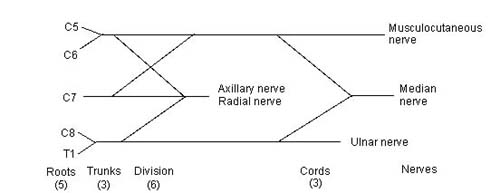
Brachial plexus injuries in adults3
Severe brachial plexus injuries cause dramatic consequences to the motor and sensory functions of the upper limb.4 Road traffic accidents have resulted in a significant increase in brachial plexus injuries.3
Milder injuries of the brachial plexus can occur, with transient symptoms and with a full recovery. Milder injuries are more common in some sports, such as martial arts, though severe brachial plexus injuries are uncommon in sports medicine.5
Epidemiology6
Non-obstetric brachial plexus injuries are most common in young men between the ages of 15 and 25.
There is a "law of 7 70s" described by Naraka.
70% of brachial plexus injuries are due to road traffic accidents. 70% of these involve a motorcycle or a bicycle. Of these, 70% sustain multiple injuries.
70% of patients sustain a lesion of the supraclavicular plexus, of which 70% will have one or several avulsion of the plexus roots; 70% of these patients will also sustain root avulsions of the lower plexus, of whom 70% will experience chronic pain.
Ballistic trauma is the second most common cause of brachial plexus injuries in the United States.
However, a Scottish study showed that a fall from standing height was the most common mechanism of injury, suggesting that injury types are likely to vary depending on the population.7
Obstetric brachial plexus injuries are rare and decreasing in incidence due to the increasing number of Caesarean sections being performed in higher income countries.8 The incidence is reported to be 1.5 per 1000 live births in the United States9 and 0.42 per 1000 live births in the UK,10 although the risk is significantly higher in lower income countries, being reported in 14.7% of births in one Ghanian study.11 Risks of brachial plexus injuries are 100 times higher in shoulder dystocia, 14 times higher in babies who are large for gestational age and 9 times higher in forceps deliveries.12
Children born in low-resource settings are more likely both to have brachial plexus injuries and to have delayed referral for specialist management.13
Signs and symptoms6
A thorough history and examination is essential. Significant bruising and swelling may suggest vascular trauma which should be assessed by examining the radial, ulnar, and brachial pulses.
Precise examination findings depend on the injury site within the brachial plexus. Upper brachial plexus injuries can present clinically as an Erb palsy, and lower plexus injuries can present with a Klumpke palsy. C5/C6 involvement leads to paralysis of the shoulder and biceps muscles. C7 involvement leads to paralysis in extending the wrist and hand muscles. C8/T1 involvement leads to paralysis of the forearm flexors and hand intrinsic muscles.14
Examination
See also the separate Neurological examination of the upper limbs article.
Sensory nerves
Pinch the nail base, pull the finger outwards, and ask about feeling anything. A burning feeling indicates continuity in the following nerves; absence does not necessarily mean the nerve is divided but may be due to neurapraxia instead.
Thumb - tests the median nerve supplied by C6.
Middle finger - tests the median nerve supplied by C7.
Little finger - tests the ulnar nerve suppled by C8.
Motor nerves
Examination can be made difficult by anomalous nerve distribution, including C4 contributing to the brachial plexus and also because many muscles are supplied by more than one motor neuron. Assessment of loss of motor function at the cervical root:
C5: shoulder movement in all directions, flexion of elbow (to some degree).
C6: flexion of elbow, rotation of forearm, flexion of wrist (to some degree).
C7: mainly a sensory trunk. (Produces generalised loss of movement in the arm, without total paralysis in any given muscle group. Always supplies the latissimus dorsi.)
C8: extension and flexion of fingers, flexion of wrist, hand movement.
T1: intrinsic muscles of the hand - eg, adduction or abduction of fingers.
Brachial plexus injuries in neonates
Obstetric palsy is classically defined as a brachial plexus injury during delivery. Caesarean delivery or being one of a multiple pregnancy is protective.12
Many cases are temporary, with full function recovering within one week (although more recent studies suggest that some neurological impairment may persist and recommend physiotherapy and occupational therapy to reduce these risks).13 However, permanent injury is not uncommon, with one study suggesting that 18.4% persisted beyond a year.15 A recent Turkish study showed that 14.3% of babies had a permanent injury.16 See also the separate Birth injuries to the baby article.
There are two types of brachial plexus paralysis in neonates: upper plexus injury or Erb's palsy, and lower plexus injury or Klumpke's palsy.
Examination
Prompt evaluation and referral is recommended.13
Erb's palsy (C5-C6 injury) - the arm is characteristically held adducted and internally rotated with the forearm pronated, hand and wrist flexed ('waiter's tip' position). The infant is unable to move the arm or shoulder. See the separate Erb's Palsy article.
Klumpke's palsy - Horner's syndrome is present, ie meiosis, ptosis, anhydrosis.
Investigations317
Plain x-rays, myelography, CT myelography, and MRI may all be indicated for the evaluation of brachial plexus. Electrodiagnostic and nerve conduction studies in association with the clinical findings can provide information regarding the location of the lesion, the severity of trauma, and expected clinical outcome.
Management18
Nerve damage causes a multifaceted clinical picture consisting of sensorimotor disturbances (pain, muscle atrophy, muscle weakness, secondary deformities). Brachial plexus injury may result in severe and chronic impairments for both adults and children. Therefore, early treatment and extensive rehabilitation are required. Psychological problems associated with brachial plexus injury may limit rehabilitation effects and increase disability.
General measures
Adult trauma:
Rehabilitation plays an important role in reducing disability. Patients who are unable or unwilling to take part in rigorous and long-lasting physiotherapy are less likely to recover.6
Pain management is essential.19
Lower energy brachial plexus injuries are more likely to spontaneously resolve and therefore conservative management is more appropriate.
Whilst urgent surgical exploration may be required if a root avulsion or laceration injury to the plexus is suspected or in cases of open injury, retained foreign body, or vascular injury requiring vessel repair, in lower intensity brachial plexus injuries this may be delayed for 3-6 months if recovery fails to materialise.6
Obstetric trauma:
Neonatal: spontaneous recovery usually occurs and can start within days but can take months.
Occupational and physiotherapy is recommended to improve the rates of recovery. Splinting has also been shown to be of benefit.13
Other treatments include botulinum toxin injection20 although its value is debated. 13
Surgical17
Specialist surgical repair in tertiary centres: options include nerve transfers, nerve grafting, muscle transfers, and neurolysis of scar around the brachial plexus.21
Phrenic nerve transfer has shown useful recovery of arm function in some patients; however, there is very little information about long-term functional and quality-of-life outcomes. There is also some evidence of consequent impairment of respiratory function. However, because patients with brachial plexus injuries are often very disabled and treatment options may be limited, the National Institute for Health and Care Excellence (NICE) recommends that phrenic nerve transfer may be considered as a treatment option.22
NICE guidance states that the evidence on the safety of free-functioning gracilis transfer to restore upper limb function in brachial plexus injury shows well-recognised complications (pain, bleeding, infection, and graft failure). However evidence on its efficacy is adequate to support the use of this procedure. This procedure should only be performed in a specialist brachial plexus unit by a multidisciplinary team including specialised physiotherapists, with input from microvascular surgeons.23
Arthrodesis of the shoulder may be considered but much more rarely in view of advances with nerve, tendon and free muscle transfers. Wrist arthrodesis may also be considered for wrist pain and gives stability to the hand.
In neonates, surgery is recommended as an early intervention, as outcome is best if repair is undertaken within six months and can be impaired if surgery is delayed until after 18 months.13
Exclusive updates for healthcare professionals
Stay informed with the latest clinical updates, professional insights, and evidence-based guidance. The Patient Pro newsletter curates essential content for healthcare professionals—delivered straight to your inbox.
By subscribing you accept our Privacy Policy. You can unsubscribe at any time. We never sell your data.
Further reading and references
- Orebaugh SL, Williams BA; Brachial plexus anatomy: normal and variant. ScientificWorldJournal. 2009 Apr 28;9:300-12.
- Luo TD, Levy ML, Li Z; Brachial Plexus Injuries. StatPearls, August 2021.
- Leinberry CF, Wehbe MA; Brachial plexus anatomy. Hand Clin. 2004 Feb;20(1):1-5.
- The Brachial Plexus; O Jones; Teach Me Anatomy
- Sakellariou VI, Badilas NK, Mazis GA, et al; Brachial plexus injuries in adults: evaluation and diagnostic approach. ISRN Orthop. 2014 Feb 9;2014:726103. doi: 10.1155/2014/726103. eCollection 2014.
- Brachial plexus injuries in the contact athlete: a narrative review; R Windmueller et al; Annals of Joint
- Belviso I, Palermi S, Sacco AM, et al; Brachial Plexus Injuries in Sport Medicine: Clinical Evaluation, Diagnostic Approaches, Treatment Options, and Rehabilitative Interventions. J Funct Morphol Kinesiol. 2020 Mar 30;5(2). pii: jfmk5020022. doi: 10.3390/jfmk5020022.
- Dean T, Levy ML, Luo TD, et al; Brachial Plexus Injuries.
- Traumatic brachial plexus injuries: a national review of epidemiology in the Scottish population over a 10-year period; C E Warwick and T Hems; Journal of Hand Surgery
- Epidemiology and surgical management of obstetric brachial plexus injury: a national cohort study; T A Sargut et al; Journal of Neurosurgery
- A brief overview of obstetric brachial plexus palsy; A Swift; British Journal of Midwifery
- Doumouchtsis SK, Arulkumaran S; Are all brachial plexus injuries caused by shoulder dystocia? Obstet Gynecol Surv. 2009 Sep;64(9):615-23.
- Prevalence and predisposing factors of brachial plexus birth palsy in a Regional hospital in Ghana: A five year retrospective study; C Yarfi et al; Pan African Medical Journal
- Foad SL, Mehlman CT, Ying J; The epidemiology of neonatal brachial plexus palsy in the United States. J Bone Joint Surg Am. 2008 Jun;90(6):1258-64. doi: 10.2106/JBJS.G.00853.
- Khabyeh-Hasbani N, O'Brien DM, Meisel EM, et al; Current Concepts in Brachial Plexus Birth Injuries: A Comprehensive Narrative Review. Plast Reconstr Surg Glob Open. 2024 Aug 22;12(8):e6083. doi: 10.1097/GOX.0000000000006083. eCollection 2024 Aug.
- Brachial plexus injury; H Knipe; Radiopaedia
- Mapping Population-Level Differences in Brachial Plexus Birth Injury: An International Meta-Analysis; H Cordray et al; The Journal of Hand Surgery
- Arslan O, Giray B, Tug N; Obstetric brachial plexus injury: risk factors and clinical follow-up results. J Turk Ger Gynecol Assoc. 2025 Sep 3;26(3):204-211. doi: 10.4274/jtgga.galenos.2025.2025-3-3. Epub 2025 Aug 22.
- Management of Adult Brachial Plexus Injuries; J R Hill et al; The Journal of Hand Surgery
- Pejkova S, Filipce V, Peev I, et al; Brachial Plexus Injuries - Review of the Anatomy and the Treatment Options. Pril (Makedon Akad Nauk Umet Odd Med Nauki). 2021 Apr 23;42(1):91-103. doi: 10.2478/prilozi-2021-0008.
- Review of rehabilitation protocols for brachial plexus injury; H Li et al; Frontiers in Neurology
- Ramachandran M, Eastwood DM; Botulinum toxin and its orthopaedic applications. J Bone Joint Surg Br. 2006 Aug;88(8):981-7.
- Hale HB, Bae DS, Waters PM; Current concepts in the management of brachial plexus birth palsy. J Hand Surg Am. 2010 Feb;35(2):322-31.
- Phrenic nerve transfer in brachial plexus injury; NICE Interventional procedures guidance, Nov 2013
- Free-functioning gracilis transfer to restore upper limb function in brachial plexus injury; Interventional procedures guidance [IPG687]. March 2021.
About the authorView full bio

Dr Philippa Vincent, MRCGP
General Practitioner, Medical Author
MB BS, Bsc, MRCGP (2000), DCH, DFSRH, DRCOG
Dr Philippa Vincent is an NHS GP working in North London.
About the reviewerView full bio

Dr Toni Hazell, FRCGP
MBBS, BSc, FRCGP, DFSRH, Dip GU med, DRCOG, DCH (London, UK, 2000)
Dr. Toni Hazell qualified from St. Mary’s Hospital Medical School and did her VTS at Northwick Park Hospital.
Article history
Article also available in English, German, Spanish, French, Italian, Portuguese, Hindi, Hebrew, Arabic, and Swedish.
Next review due: 1 Apr 2031
1 Oct 2026 | Latest version

Ask, share, connect.
Browse discussions, ask questions, and share experiences across hundreds of health topics.

Feeling unwell?
Assess your symptoms online for free
More in neurology
- Cerebral palsy
- Cheyne-Stokes and abnormal patterns of respiration
- Deafness in children
- Examination of the cranial nerves
- Examination of the spine
- Gait abnormalities in children
- Giant cell arteritis
- Hamartomas
- Hemifacial spasm
- Krabbe's disease
- Lambert-Eaton myasthenic syndrome
- Limb-girdle muscular dystrophy
- Meningococcal disease
- Multiple system atrophy
- Myasthenia gravis
- Narcolepsy and cataplexy
- Neural tube defects
- Neuroblastomas
- Neurofibromatosis
- Nightmare disorder