Borsite olecranica
Student's elbow
Revisione paritaria di Dr Hayley Willacy, FRCGP Ultimo aggiornamento di Dr Doug McKechnie, MRCGPUltimo aggiornamento 2 Gennaio 2024
Rispetta le linee guida editoriali
- ScaricaScarica
- Condividi
- Language
- Discussione
- Versione audio
- Aggiungi alle fonti preferite su Google
La borsite olecranica è una condizione in cui c'è infiammazione e gonfiore morbido nella parte posteriore del gomito. L'olecrano è la punta ossea del gomito. Una borsa è un sacchetto morbido di liquido che si trova sopra un'articolazione nel corpo. '-ite' significa infiammazione.
A colpo d'occhio
Olecranon bursitis is inflammation of the fluid-filled sac behind the elbow.
Symptoms include swelling behind the elbow, sometimes like a soft ball.
Non-infected bursitis is often painless; infected bursitis causes pain, redness, and fever.
Common causes include repeated mild injury or a one-off blow to the elbow.
Treatment includes rest, ice, avoiding pressure, and sometimes anti-inflammatory medication.
Antibiotics are needed if the bursitis is caused by an infection.
Protecting your elbow by using pads can help prevent it from returning.
Elbow with olecranon bursitis
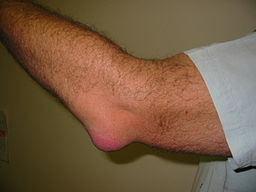
© User:NJC123, via Wikimedia Commons
What is olecranon bursitis?
Olecranon bursitis, also called elbow bursitis, is when the fluid-filled sac behind the elbow, called the olecranon bursa, becomes inflamed, swollen, and painful.
What is a bursa?
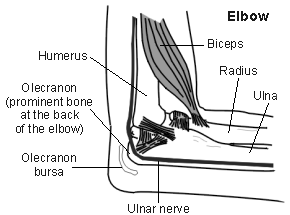
A bursa is a small sac that contains a small amount of fluid. The fluid is similar to the fluid in joints (synovial fluid). There are several bursae in the body, including one just over the olecranon. Bursae help to make movement smooth between bones which 'stick out' and the overlying skin.
Normally the bursa cannot be felt but when it gets inflamed, it becomes larger so that you can see the bulge and feel a soft lump over the back of your elbow. It is sometimes said to resemble the shape of a goose egg or a golf ball, although it may come in different shapes and sizes.
Diagram: elbow showing olecranon bursa
What are the symptoms of olecranon bursitis?
You cannot normally feel or see a bursa. If the olecranon bursa is inflamed then it causes a thickness and swelling over the back of the elbow. The bursa may also fill with fluid and it then looks like a small soft ball.
There are two types of olecranon bursitis:
Infected (septic).
Non-infected (aseptic).
It is not always obvious which type it is, but the symptoms tend to be slightly different. The non-infected type is the most common.
Aseptic bursitis symptoms
Most cases of aseptic olecranon bursitis are painless, or are only mildly painful. The movement of the elbow joint is not affected. It may hurt to put any pressure on your elbows - for example, if you lean your elbow on a hard surface. It may also hurt a little when you bend your elbow.
The swelling looks the same colour as the rest of your skin, or slightly pink. It may feel the same temperature as the rest of your skin, or may be slightly warm. The swelling is soft rather than hard when you touch it, and you may be able to feel the fluid moving within it when you press on it.
A bursitis associated with another condition such as artrite may not be painful itself but you will have other symptoms related to the arthritis, such as joint pains.
Septic olecranon bursitis symptoms
If the bursa is infected then you will usually develop:
Dolore.
Redness and tenderness behind the elbow.
Redness and swelling spreading away from the elbow.
Una temperatura elevata (febbre).
A graze or wound on the skin over the swelling, where the germs (bacteria) entered.
What are the causes of olecranon bursitis?
There are a number of possible causes of olecranon bursitis:
Mild but repeated injury is thought to be the common cause of olecranon bursitis. For example, people who lean on their elbows a lot cause friction and repeated mild injury over the olecranon.
Repeated elbow movements may be a cause in certain athletes. For example, those whose sports involve throwing by raising the arm above the head (such as cricket or baseball players, javelin throwers) or weightlifters.
One-off injury such as a blow to the back of the elbow may set off inflammation.
Artrite. One or more bursae may become inflamed as part of a generalised arthritis. (Nota: most cases of olecranon bursitis are not associated with arthritis.) Types of arthritis which can be associated with bursitis include artrite reumatoide, gotta e spondilite anchilosante.
Infezione of a bursa. This may occur if there is a cut in the skin over a bursa, which allows in germs (bacteria). Some illnesses may make infection more likely - for example, diabete or conditions where the immune system does not work as well as normal. There is not always an obvious cause for the infection.
Unknown (idiopathic). Many cases occur for no apparent reason. However, it is possible that some of these are due to a mild injury that has been forgotten.
How is olecranon bursitis diagnosed?
If you have a straightforward case of olecranon bursitis, the doctor may be able to diagnose it without any tests. The swelling is very typical and because the elbow is so close to the skin, it is usually quite easy to feel.
However, other tests are sometimes needed to rule out other causes of elbow swelling, such as infection (artrite settica), gout or rheumatoid arthritis.
Tests which might be needed include esami del sangue and an ecografia. If you have had a significant injury, an radiografia might be needed to make sure there is no break (fracture). Also, sometimes people who have had repeated episodes of olecranon bursitis develop an olecranon spur - a bony growth - which can be seen on an X-ray.
If infection ('septic olecranon bursitis') is suspected, the bursal fluid in the swelling may be drained (aspirated) by the doctor. This may be done by your GP in the surgery in some cases.
A sample is then sent to the lab to see which germs (bacteria) are causing the infection. This can then help guide the right treatment for you.
Do I need to see a specialist for olecranon bursitis?
Your GP may often be able to diagnose and treat you without you needing a referral to a specialist. However, if there is doubt about the diagnosis, or if you have an associated condition such as rheumatoid arthritis, you may be referred.
Also if your GP is not practised at aspirating these swellings, he or she may refer you to someone with plenty of experience.
What is the treatment for olecranon bursitis?
In many cases, olecranon bursitis clears up on its own with simple care such as resting the elbow, avoiding pressure on it, and applying ice packs. Some people find a compression bandage on the elbow makes it more comfortable.
As long as there is no infection, over time most cases of olecranon bursitis will then settle on their own.
Other treatments advised in some cases include:
Anti-inflammatory medication (come ibuprofene, naprossene, diclofenac, etc) may be prescribed to reduce inflammation and swelling. Paracetamolo is another option if the elbow is painful.
Draining the fluid (aspiration) can be done by a healthcare professional with a sterile needle and syringe if a lot of fluid builds up. However, the fluid tends to build up again after being drained. Therefore, you may be advised to wear a tight pressure bandage for a while after the fluid has been drained, to prevent it building up again.
A iniezione di steroidi into the bursa may cure the problem. Steroids are good at reducing inflammation. However, steroid injections sometimes cause infection in the bursa.
Chirurgia to remove the bursa is an option if the above do not work.
Antibiotici are needed if the cause of the bursitis is an infection. Normally an antibiotic such as flucloxacillina oppure eritromicina is used until the results of the tests on the aspirated fluid are available. Then the choice of treatment can be changed if necessary and directed at the exact germs (bacteria) causing the infection. Flucloxacillin and erythromycin treat the most common types of germs which cause olecranon bursitis.
If you protect the elbow from excessive friction and rubbing it may prevent further bouts of olecranon bursitis. This may mean using elbow pads if you need to lean on your elbows whilst working.
Will olecranon bursitis come back after treatment?
Not usually. If you tend to lean on your elbows then avoiding this may make it less likely that an olecranon bursitis will come back again. Try to avoid this position, or use a cushion or pad so your elbows don't rest on a hard surface.
Scelte del paziente per Dolore articolare
/og.png)
Ossa, articolazioni e muscoli
Disturbo dell'Articolazione Temporomandibolare (TMD)
Temporomandibular disorders are problems affecting the jaw joint and the muscles and other tissues around the jaw joint. These disorders usually cause pain or reduced movement of the jaw, and sometimes sounds such as clicking or grating of the jaw joint. There are various causes but generally temporomandibular disorders are not serious and often improve with simple treatments.
di Dott.ssa Rosalyn Adleman, MRCGP

Ossa, articolazioni e muscoli
Problemi all'anca
I problemi all'anca sono piuttosto comuni. La causa può essere evidente, come un infortunio che si verifica improvvisamente mentre si pratica sport. A volte la causa non è così chiara e sarà necessario farsi controllare da un medico o da un fisioterapista.
di Dr Rachel Hudson, MRCGP
Domande frequenti
What is a soft lump on elbow?
A soft lump on the elbow, especially over the back of it, is often a sign of olecranon bursitis. This condition occurs when the fluid-filled sac (bursa) behind your elbow becomes inflamed and swells. When this happens, it can look and feel like a soft ball, sometimes compared to a goose egg or a golf ball.
How do you know if elbow bursitis is infected?
You might suspect an infection if you experience increased pain, redness, and tenderness spreading from the elbow, along with a high temperature (fever). There might also be a visible graze or wound on the skin over the swelling where bacteria could have entered.
Is draining elbow bursitis painful?
The article doesn't specifically mention the pain level during the draining procedure itself, but it does state that aspiration (draining the fluid) is done by a healthcare professional with a sterile needle and syringe. After draining, a tight pressure bandage might be advised to prevent fluid from building up again, which could cause discomfort.
What is a bursa and why does it get inflamed in the elbow?
A bursa is a small, fluid-filled sac that helps to provide smooth movement between bones and overlying skin. In the elbow, the olecranon bursa can become inflamed due to repeated mild injury, such as frequently leaning on the elbows, repeated elbow movements in certain sports, a single blow to the elbow, or as part of a generalised arthritis condition. It can also become inflamed due to an infection or for no apparent reason.
Can I treat elbow bursitis at home without seeing a doctor?
In many cases, olecranon bursitis can clear up with simple home care, especially if it's not infected. This includes resting the elbow, avoiding pressure on it, and applying ice packs. Some people find a compression bandage helpful. Over-the-counter anti-inflammatory medication or paracetamol can help with pain. However, if you suspect an infection or if symptoms worsen, you should seek medical advice.
Ulteriori letture e riferimenti
- Blackwell JR, Hay BA, Bolt AM, et al; Olecranon bursitis: a systematic overview. Shoulder Elbow. 2014 Jul;6(3):182-90. doi: 10.1177/1758573214532787. Epub 2014 May 6.
- Borsite olecranica; NICE CKS, Maggio 2021 (accesso solo UK)
- Pangia J, Rizvi TJ; Olecranon Bursitis. StatPearls, July 2021.
- O'Shea NE, Tadi P; Olecranon Bursa Aspiration. StatPearls, Sept 2021.
Informazioni sull'autoreVisualizza il profilo completo

Dr Doug McKechnie, MRCGP
Scrittore Medico
MA, MBBS, MSc, DRCOG, MRCP(UK), MRCGP(2021), FHEA
Il dottor Doug McKechnie è un medico di base del NHS che lavora a Londra. Lavora a tempo pieno in ambito clinico ed è anche Vice Responsabile del modulo di Pratica Clinica e Professionale presso la Scuola di Medicina dell'University College London.
Informazioni sul recensoreVisualizza il profilo completo

Dr Hayley Willacy, FRCGP
Medico di base, Autore medico
MBChB (1992), DRCOG, DFFP, MRCOG (Part 1) MRCGP (2007), DFSRH (2013), MSc - medical education (2020)
La Dott.ssa Hayley Willacy era un medico di base del NHS che lavorava nel nord-ovest dell'Inghilterra, e si è ritirata dalla pratica clinica nel 2022 dopo 30 anni.
Storia dell'articolo
Le informazioni su questa pagina sono scritte e revisionate da clinici qualificati.
Articolo disponibile anche in Inglese, Tedesco, Spagnolo, Francese, Italiano, Portoghese, Hindi, Ebraico, Arabo, and Svedese.
Prossima revisione prevista: 31 Dic 2028
2 Gennaio 2024 | Ultima versione

Chiedi, condividi, connettiti.
Esplora le discussioni, fai domande e condividi esperienze su centinaia di argomenti di salute.

Non ti senti bene?
Valuta i tuoi sintomi online gratuitamente
Iscriviti alla newsletter di Patient
La tua dose settimanale di consigli sulla salute chiari e affidabili - scritti per aiutarti a sentirti informato, sicuro e in controllo.
Abbonandoti accetti i nostri Informativa sulla Privacy. Puoi annullare l'iscrizione in qualsiasi momento. Non vendiamo mai i tuoi dati.
Più su ossa, articolazioni e muscoli
- Spondiloartrite assiale
- Costole rotte o contuse
- Braccio superiore rotto
- Costola cervicale
- Fibromialgia
- Sostituzione del ginocchio
- Sclerosi multipla
- Debolezza muscolare
- Dolore al collo
- Osteoartrite
- Osteomielite
- Prevenire l'osteoporosi indotta da steroidi
- Artrite psoriasica
- Artrite reumatoide
- Artrite settica
- Periostite tibiale
- Anestetico spinale
- Problemi del disco spinale
- Disturbo dell'Articolazione Temporomandibolare (TMD)
- Gomito del tennista