Head lice and nits
Peer reviewed by Dr Doug McKechnie, MRCGPLast updated by Dr Colin Tidy, MRCGPLast updated 6 Mar 2025
Meets Patient’s editorial guidelines
- DownloadDownload
- Share
- Language
- Discussion
- Audio Version
- Add to preferred sources on Google
In this series:Head lice treatment and prevention
Head lice are small insects that live in human hair and feed on blood from the scalp. Their eggs are called nits.
At a glance
Head lice are tiny grey/brown insects that live in human hair and feed on the scalp.
Nits are the empty yellow-white eggshells left after headlice hatch.
An itchy scalp is a common symptom, but it can take about three months for an itch to develop.
You can check for head lice by using a special fine-toothed detection comb on wet or dry hair.
Head lice can be treated with medicated lotions, sprays, or by wet combing.
Head lice are spread by close hair-to-hair contact and are not a sign of poor hygiene.
In this article:
Video picks for Infections
Continue reading below
What do head lice look like?
What are nits?
Head lice are tiny grey/brown insects. They are about the size of a sesame seed - the seeds on burger buns. Head lice cling to hairs but stay close to the scalp which they feed off. Head lice lay eggs which hatch after 7 to 10 days. It takes about 7 to 10 days for a newly hatched louse to grow into an adult and start to lay eggs.
Nits are the empty yellow-white eggshells which are left when the lice hatch. Nits look like dandruff but stick strongly to hair. Unlike dandruff, you cannot easily brush out nits.
Where do head lice come from?
Back to contentsMale and female head lice size comparison
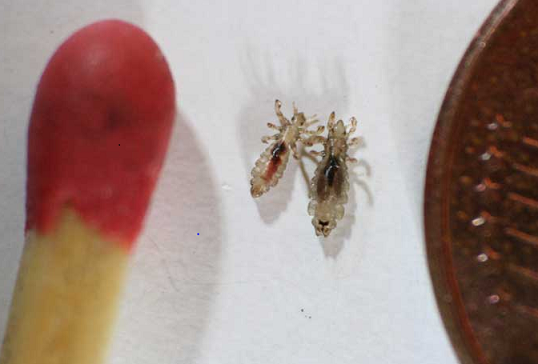
© Pediculosis, CC BY-SA 3.0, via Wikimedia Commons
Head lice look like tiny little ants, and the eggs look like white spots clinging to hair strands. Nits look a lot like dandruff; in fact it's more or less impossible to tell the difference.
Lice feed from the blood on your scalp, and it is the bites - and your skin's reaction to the bites - which make you itch.
The more time you spend with your head in close contact with someone who has nits, the more likely you are to catch them yourself. While the eggs (nits) cannot move, lice can walk from one head to another. The more hair available for lice transfer, the more likely this transfer is. So it's more common in kids with longer hair, and more likely if hair isn't tied up.
Head lice don't jump and they don't fly, so you do have to have hair-to-hair contact. Fortunately, lice don't live for very long off a human head, but they do survive for a day or two, so you can also catch them by sharing a comb or hairbrush with someone with lice.
Continue reading below
Head lice symptoms
Back to contentsItchy scalp. Not all scalp itching is caused by head lice, and head lice don't always cause an itch. Many people with head lice do not have any symptoms. However, an itchy scalp occurs in some cases. This is due to a skin reaction to the lice bites or saliva, not due to their biting as such, or their movement on your head. It can take about three months for an itch to develop after you are infested with lice. Therefore, you may not notice that you have head lice for a while and you may have passed them on to others by the time you are aware of them. Head lice do not wash off with normal shampoo.
Rash on the scalp. Head lice do not usually cause any other medical problems. Very occasionally, the scratching can cause a rash on the scalp, and occasionally this can cause an infection.
Swollen lymph glands. Glands in the neck can get bigger in response to this infection.
It can be embarrassing for children or parents to admit they have found head lice. Sometimes parents can be too embarrassed to tell the school, or their children's friends. This may encourage spread, as others may not be aware they have been exposed. Sometimes repeat infestations can be frustrating for children and their families.
The number of lice that may be on one person can vary greatly. There may be just a few in some; in other cases there are more than 100. Very rarely in very severe cases there may be over 1,000. Typically in the UK, there are around 30 lice present on each affected person's head.
How to know if you have nits?
Back to contentsThe only way of telling for sure whether you have head lice is to see a live louse. If someone has quite a lot of lice, you may sometimes be able to see them just by looking through their hair. The best way to check for lice, however, is with a special nit detection comb. These combs have very fine teeth designed to pull out lice. If you have head lice, when you comb through hair, one or more black nits come out on the comb. You can buy the special comb from your chemist.
Some people advise that you do this to children's hair regularly, about once a week. This may not always be necessary but can be helpful if people you are in contact with have head lice, or if it is a recurring problem.
Detection combing: wet hair method
This will take 5-15 minutes to check each head, depending on hair length and thickness. It is also used as a head lice treatment .
Wash the hair in the normal way with ordinary shampoo.
Rinse out the shampoo and put on lots of ordinary conditioner.
Comb the hair with a normal comb to get rid of tangles.
When the hair is untangled, switch to a detection comb. This is a special fine-toothed comb to remove head lice and nits. (The teeth of normal combs are too far apart and the teeth of 'nit combs' are too close together.) Most pharmacies stock detection combs.
Bug Buster® detection combs are available on prescription. You can also get them by UK mail order from Community Hygiene Concern.
The Hedrin® detection comb is not available on prescription but can be bought from pharmacies.
Slot the teeth of the detection comb into the hair at the roots so it is touching the scalp.
Draw the detection comb through to the tips of the hair.
Make sure that all parts of the hair are combed by working around the head.
Check the comb for lice after each stroke. A magnifying glass may help.
If you see any lice, clean the comb by wiping it on a tissue or rinse it before the next stroke.
After the whole head has been combed, rinse out the conditioner.
Repeat the combing procedure in the wet hair to check for any lice that might have been missed the first time.
Detection combing: dry hair method
This will take at least 3-5 minutes to check each head, depending on hair length and thickness. Although dry combing is an option to detect head lice, it is not useful as a treatment.
Untangle the dry hair, using an ordinary brush and comb.
Once the comb moves freely through the hair without dragging, switch to a detection comb, as described above.
Starting from the base or the side of the scalp, comb the hair from the scalp down to the end of the hair. Comb each section of hair 3-4 times before moving to an adjacent section.
Look for lice as the comb is drawn through the hair.
If a possible louse is seen, trap it against the face of the comb using your thumb. This avoids the risk of the louse being repelled by static electricity as the comb is pulled out of the hair.
Continue combing the hair section by section until the whole head of hair is combed through.
See the separate article called How to check your child for head lice and nits for more details.
Continue reading below
Head lice treatment
Back to contentsThe main ways of treating head lice and nits are:
Medicated lotion and spray treatments.
Wet combing.
Most insecticides need to be used twice, and combing has to be done several times over at least two weeks. Everything that you need to treat head lice can be bought over the counter - NHS England has advised doctors not to prescribe for this problem and so it is best to see a pharmacist rather than your doctor.
It is almost impossible to prevent head lice entirely, although if you have a child with long hair, tying it back will reduce the risk of catching them. Detection combing once a week will allow you to pick up and treat head lice early.
Read more detail on treating and preventing head lice.
Who gets head lice?
Back to contentsHead lice are common all over the world.
They are not a sign of dirty hair or poor hygiene. Close hair-to-hair contact is usually needed to pass lice on. Head lice cannot jump or fly but walk from one head to another. They soon die when away from hair and they do not live for long in clothes, bedding, etc. However, they can occasionally be passed by sharing items such as brushes, combs, hats or bedding. Most head lice infections are caught from family or close friends who are not aware that they have head lice.
Head lice are more common in young children with long hair and, partly, for this reason, tend to be more common in girls. The more children there are in any one family, the more common head lice are.
Patient picks for Infections
Children's health
Hand, foot and mouth disease
Hand, foot and mouth disease is usually a short mild illness that mainly affects children. Most children fully recover within ten days, and usually less. Serious complications occur rarely. This disease is not related to the disease with a similar name which affects animals.
by Dr Toni Hazell, MRCGP

Children's health
Febrile seizure
A febrile seizure is a convulsion that occurs in some children with a high temperature (fever). The vast majority of febrile seizures are not serious. Most occur with mild common illnesses. Full recovery with no permanent damage is usual. The main treatment is aimed at the illness that caused the fever.
by Dr Philippa Vincent, MRCGP
Frequently asked questions
Are nits and head lice the same thing?
No, they are not the same. Head lice are the tiny grey/brown insects that cling to hairs and feed from the scalp. Nits are the empty yellow-white eggshells left behind after the lice hatch. Nits stick strongly to hair and look like dandruff but cannot be easily brushed out.
How many head lice can someone have?
The number of head lice on a person can vary greatly. Some people might only have a few, while others could have over 100. In very rare and severe cases, there might be more than 1,000. In the UK, it's typical to find around 30 lice on an affected person's head.
Why do head lice cause an itch?
The itching associated with head lice is due to your skin's reaction to the lice bites or their saliva, not their movement or direct biting. It can take about three months for an itch to develop after an infestation, meaning you might not realise you have them for some time.
Can head lice live on clothes or bedding?
Head lice soon die when they are away from a human head and do not live for long on clothes or bedding. While they can occasionally be passed by sharing items like brushes, combs, hats, or bedding, they primarily need hair-to-hair contact to transfer.
Can head lice cause swollen lymph glands?
Very occasionally, if the scratching from head lice leads to a rash on the scalp and this causes an infection, the glands in the neck can become larger in response.
Further reading and references
- Head lice (Pediculosis); Public Health England. April 2013, last updated January 2018.
- Head lice; NICE CKS, November 2021 (UK access only)
- Gunning K, Kiraly B, Pippitt K; Lice and Scabies: Treatment Update. Am Fam Physician. 2019 May 15;99(10):635-642.
Continue reading below
About the authorView full bio

Dr Colin Tidy, MRCGP
General Practitioner, Medical Author
MBBS, MRCGP, MRCP (Paediatrics), DCH
Dr Colin Tidy is an NHS Doctor, based in Oxfordshire.
About the reviewerView full bio

Dr Doug McKechnie, MRCGP
Medical Writer
MA, MBBS, MSc, DRCOG, MRCP(UK), MRCGP(2021), FHEA
Dr Doug McKechnie is an NHS GP working in London. He works full-time clinically and is also the Deputy Lead for the Clinical and Professional Practice module at University College London Medical School.
Article history
The information on this page is written and peer reviewed by qualified clinicians.
Next review due: 5 Mar 2028
6 Mar 2025 | Latest version

Ask, share, connect.
Browse discussions, ask questions, and share experiences across hundreds of health topics.

Feeling unwell?
Assess your symptoms online for free
Sign up to the Patient newsletter
Your weekly dose of clear, trustworthy health advice - written to help you feel informed, confident and in control.
By subscribing you accept our Privacy Policy. You can unsubscribe at any time. We never sell your data.